7 Deadly Sins Test: A Guide to Your Seven-Side Profile
Published
In this guide
Choose your quiz, understand the seven categories, and learn why your result can be more interesting than a single label.
A 7 deadly sins test turns familiar situations into seven separate scores: pride, envy, wrath, sloth, greed, gluttony, and lust. On Seven Sides, those scores reflect how you answer statements about recent everyday experiences. They are for entertainment and reflection, not a judgment of your character.
You might want to know which tendency stands out, why two results are close, or whether you should take the longer version. This guide explains the choices and the calculation behind your profile, so you can spend less time guessing what a number means.
Ready to answer? Start the 7 deadly sins test for the quick version, or read the comparison below before choosing.
Quick or full: which 7 deadly sins test should you take?
Both versions of our 7 deadly sins quiz use the same seven categories and response scale. The difference is how many situations you consider before seeing your profile.
| Feature | Quick version | Full version |
|---|---|---|
| Total statements | 21 | 70 |
| Statements per category | 3 | 10 |
| Minimum usable answers per category for a complete profile | 2 | 8 |
| Best reason to choose it | You want a short introduction to your seven sides | You want to consider more situations within each side |
The longer version includes the quick questions and adds further situations. More items offer more context; they do not make the result a clinical assessment. If you already tried the quick version and want that extra detail, open the full 7 deadly sins test.
You don't need to complete both. Choose the version you feel like answering carefully, without treating the longer one as a way to obtain a more flattering label.
What do the seven categories mean?
The names come from Christian moral tradition. The traditional list of capital sins includes avarice, another word for greed. Our 7 deadly sins test uses these names for specific everyday patterns. It does not ask about your religious beliefs or match you to an anime character.
Pride: when being right gets in the way of listening
A correction arrives, and you start defending yourself before considering it. Or an achievement feels less satisfying because nobody noticed. These are the kinds of situations behind the Pride category. Enjoying your abilities or disagreeing with someone isn't enough on its own to explain a high score; the question is how you respond when your image feels challenged.
Envy: when someone else's progress feels like your setback
A friend shares good news and you immediately compare their life with yours. You can care about them and still recognize that reaction. Envy questions look at the comparison, rather than assuming every ambition is a problem. Ask whether someone else's success gives you an idea to pursue or leaves you feeling smaller.
Wrath: when an argument outlasts the moment
You reply sharply while upset, then keep returning to the exchange afterward. Wrath questions focus on reactions and lingering conflict. Feeling angry about something unfair does not settle the answer. Think about what you actually said or did, and how long the event continued to occupy your attention.
Sloth: when an available first step keeps getting postponed
You have time and energy to begin an uncomfortable task, but find another small job to do instead. That is different from needing sleep, recovery, help, or resources. In this quiz, avoidance matters in the context of what you could reasonably do. Don't translate a necessary break into a negative verdict about yourself.
Greed: when enough keeps moving
You have what you need, but collecting more options still feels urgent. The questions include wanting more despite having enough and holding onto opportunities you won't use. Planning ahead or having a goal isn't automatically greed. Consider whether you can recognize the point where your original need has been met.
Gluttony: when continuing replaces enjoying
A short break becomes a long scroll, even after the content stops being fun. This category looks at stopping points in everyday activities. It does not score body size, appearance, or food choices. Greed concerns getting more; gluttony, as framed here, concerns continuing beyond the limit you meant to keep.
Lust: when attraction changes your chosen pace
Attraction captures your attention and makes you rush a choice you intended to consider slowly. Lust questions ask about that pull and the ability to keep your chosen pace. Being attracted to someone is ordinary. The useful distinction is between enjoying the feeling and letting it decide what happens next.
Answer the 7 deadly sins quiz with real examples
Before starting, choose a typical stretch of recent life. Use that same reference period throughout. Otherwise, one answer may describe your hardest workday while the next describes an unusually relaxed holiday.
Read the whole statement. “I defend my view before considering their point” asks about the order of your response, not whether you ever defend an opinion. Picture a specific conversation, then choose the response that best fits your usual experience.
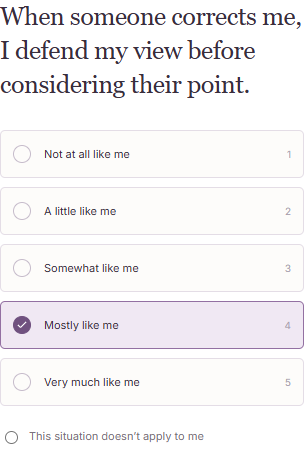
Seven Sides question example. Use the separate not-applicable option when you lack a relevant experience to answer from.
The 7 deadly sins quiz distinguishes “not like me” from “this situation doesn't apply.” The first is a usable response about your behavior. The second leaves that statement out of the calculation. Neither option should be chosen to steer the result toward a preferred title.
How the 7 deadly sins test calculates a score
Each regular answer receives a value from 0 to 4. Some statements describe the opposite of the tendency being scored. For those, the calculation reverses the value: 0 becomes 4, 1 becomes 3, and 2 stays 2.
For each category, we average the usable adjusted values and multiply by 25. Here is an illustrative quick-version calculation:
| Step | Value |
|---|---|
| First ordinary statement | 4 |
| Second ordinary statement | 3 |
| Opposite-direction statement, answered 2 | 4 − 2 = 2 |
| Average adjusted response | (4 + 3 + 2) ÷ 3 = 3 |
| Category score | 3 × 25 = 75 |
A 75 in the 7 deadly sins test is therefore a response score out of 100. It is not a percentile, a measure of moral worth, or a claim that you behave that way 75 percent of the time.
Each category has its own calculation. Seven scores of 50 are possible: nothing requires the bars to total 100. A missing or non-applicable answer isn't treated as disagreement, and the minimum-answer rule prevents a complete profile from resting on too few usable answers in a category.
Why your result may have more than one leading side
Your 7 deadly sins test profile includes all seven bars because one headline can leave out useful context. A clear leader gives you somewhere to start, but a nearby second score may describe another part of the same situation.
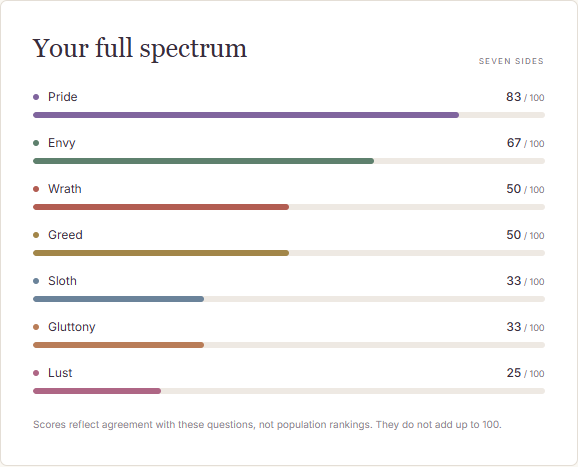
Demonstration profile, not a real user's record. The seven bars are independent scores.
The 7 deadly sins quiz also allows results without a dominant side. Low scores across the board, closely grouped scores, or broadly high scores can receive a general heading rather than an artificially decisive winner. Closely leading categories can share the spotlight.
Read those outcomes literally: they describe the pattern of answers in this attempt. A flat chart doesn't mean you have no personality. Several high scores don't mean you are worse than someone whose bars are lower.
Common questions about your profile
Can a retake give me a different result?
Yes. You may remember different situations, interpret a statement differently, or answer for a different period. If you want to compare two attempts at the 7 deadly sins test, use the same version and a similar frame of reference. A change alone doesn't prove a lasting change in your habits.
Is this a scientifically validated personality assessment?
No. The questionnaire is an original entertainment exercise. Its scores do not diagnose conditions or establish how you compare with a representative population. Use a recognizable example as a conversation starter, not as proof about yourself or another person.
What should I do with a result that feels accurate?
Choose one small observation. If Pride stands out, notice what you do immediately after receiving feedback. If Gluttony resonates, decide when a break will end before you begin. You don't need a self-improvement project for every bar; one concrete example is plenty.
You can return to the 7 deadly sins quiz whenever you feel curious. Keep the question behind the label in mind: which situation did you recognize, and what would you like to understand about it?
Related resources
- Seven Sides project guide on GitHub — example questions, scoring explanations, and illustrations of seven-side profiles.